Why is INEOS really mothballing Hull?
EnabledFuture · 24 September 2026
© 2026 EnabledFuture. All rights reserved.
Since INEOS’s decision to idle its acetyls units at Saltend, Hull, Sir Jim Ratcliffe has made scathing public comments about UK economic policy and industrial strategy. In doing so he has left out part of the causation: INEOS’s own role in the global acetic acid business.
A second part of the Hull story has also been missed in this week’s coverage. That is the blow the idling represents to UK catalysis infrastructure, at a moment when national energy security and sovereignty need it more than ever.
Sir Jim is right about one important thing. British chemical production has a serious energy-cost problem. What does not follow is that UK government policy, by itself, explains why INEOS is mothballing Hull.
This article looks at how INEOS, like many other chemical licensors and producers, ended up competing against itself globally and came up short in its higher-cost regions. These were complex board-level decisions rather than poor ones. That is all the more reason to disentangle them.
What did INEOS actually announce?
On 22 September 2026, INEOS announced that all three of its acetyls production units at Saltend would be mothballed until further notice. It has not announced a permanent closure. Sir Jim Ratcliffe was quoted by The Guardian as saying: “I’m sure people will find it hard to believe that we are being forced to mothball some of the most efficient plants in Europe … we just cannot compete.” The same article quoted him describing the UK government’s energy policy as “leading to economic vandalism on an industrial scale”.
Trade press coverage adds the scale: 500,000 t/y of acetic acid and 350,000 t/y of acetic anhydride and ethyl acetate; 245 INEOS staff directly affected, with up to 755 more across the site’s supply chain.
The UK gas price situation
Reuters reported UK front-month gas at around $23.51/MMBtu against $2.84/MMBtu at Henry Hub in the United States: a contemporaneous differential of about 8.3 times. Ratcliffe used INEOS’s own comparison of 12 times the US level and eight times the Chinese level, the Chinese figure referring to coal-based production. Whichever comparison is used, the underlying energy disadvantage is substantial, even though the precise ratio depends on the energy source, the contract and the plant configuration.
The longer history of UK industrial energy pricing puts September’s number in context. The Office for National Statistics found that UK industrial electricity prices in 2023 were 46 per cent above the median of reporting IEA countries and roughly four times those in the US and Canada. Industrial gas prices followed a different pattern, sitting 7 per cent below the IEA median in the same year. The ONS attributes the escalation in wholesale gas costs since 2021 first to international supply-chain pressure as the world economy recovered from the pandemic, then to Russia’s invasion of Ukraine, with the UK and the rest of Europe increasingly reliant on more expensive imported LNG.
Figure 1. UK non-domestic gas and electricity prices for very large consumers, 2004 Q1 to 2026 Q1 (DESNZ Quarterly Energy Prices, Table 3.4.1, excluding CCL), and the spot gas differential of 22 September 2026 (Reuters).

The latest price shock has been amplified by disruption arising from conflict in the Middle East. Energy policy therefore forms part of Hull’s operating environment alongside an international gas market whose movements are not determined in Westminster.
INEOS’s global acetic acid business: from the 2020 BP deal to today
The wider question begins with the structure of INEOS Acetyls itself. Hull is one production location inside a multinational production, technology and commercial system. INEOS bought that system from BP for $5 billion, roughly £4.05 billion at the exchange rate when the deal was agreed in June 2020, and completed the purchase on 1 January 2021.
The transaction covered 15 sites and 10 major joint ventures across aromatics and acetyls, so it would be misleading to allocate the whole purchase price to acetic acid. It did, nonetheless, transfer to INEOS a global acetyls platform: the Hull operations, the Asian joint ventures, the technology and intellectual property, the commercial relationships, and interests spanning several major production centres. Sir Jim Ratcliffe described the acquisition at the time as “extending our position in global petrochemicals and providing good scope for expansion and integration with our existing business”.
That acquisition matters to the present argument because ownership changed the nature of the competitive problem. INEOS did not subsequently face American and Asian acetic acid production solely as an outside market force. It owned, part-owned, supplied technology to, supported or commercially participated in important parts of that production system.
INEOS Quattro’s 2024 annual report describes the five Asian acetyls joint ventures as partnerships with “leading producers in the region benefiting from site integration and advantageous feedstock supply”. INEOS holds board appointment rights at each venture, is responsible for their technology and catalyst support, is their sole supplier of catalyst, and holds exclusive off-take rights for all of their exports. According to S&P Global, cited in the same report, INEOS is the world’s second-largest acetic acid producer with about 14 per cent of global capacity. Asia is its largest region by sales volume and capacity, North America is second, and Europe is the smallest.
The same report records the capital trail. In 2020 and 2021, spanning the handover from BP, the business invested in a debottlenecking project and a new VAM plant at its Ulsan joint venture in South Korea. In 2024 it converted Ulsan’s feedstock from low-sulphur fuel oil to natural gas, a project INEOS expects to improve the joint venture’s economic position and add capacity. At Chongqing it invested in a 70,000 t/y debottleneck commissioned in 2022.
Hull did receive significant investment. In July 2025 INEOS completed a £30 million project converting part of the site’s energy supply from natural gas to hydrogen produced as a co-product of existing processes, which the company says cut the site’s carbon emissions by 75 per cent. Management was prepared to spend money at Saltend; the site was not left technologically frozen after the BP acquisition. But the capital deployed elsewhere served a different purpose: it expanded, secured or improved production in lower-cost regions.
Texas City is the clearest example. Before INEOS owned the site, Eastman operated its 600,000 t/y acetic acid plant there under an INEOS Cativa® licence, and INEOS marketed the output. The 2024 annual report states that the Acetyls business received 63 per cent of the profits from that arrangement. INEOS therefore already had direct economic exposure to US acetic acid production while Hull remained its European base.
In December 2023 INEOS converted that relationship into ownership, buying the Texas City site from Eastman for $490 million, about £386 million at the completion-date exchange rate. The transaction included the 600,000 t/y acetic acid unit and the site’s third-party activities. INEOS described the asset as “strategically important” and “in a cost advantaged location”, and its acquisition announcement emphasised access to competitively priced feedstocks. The logic was straightforward: ownership gave INEOS full participation in a large US Gulf Coast producer whose energy and feedstock position was structurally better than anything available to Hull.
The direction of travel had been visible before the purchase. In June 2022 INEOS launched a feasibility study for a new world-scale acetic acid and derivatives complex on the US Gulf Coast, identifying “the abundance of competitively priced feedstocks” as the region’s advantage. In the same announcement it said it would not proceed “at present” with a previously announced VAM plant in the UK “given the volatile and uncompetitive energy costs outlook”. The Texas City acquisition later gave the business an established route to the position it had been exploring through a greenfield project.
By 2024 the relationship between US production and European competitiveness was being described explicitly inside INEOS. In INEOS in Review 2024 (pages 7–8), David Brooks, chief executive of INEOS Acetyls, said the business had found it “very difficult to remain competitive during the past two-to-three years because of high natural gas prices in Europe, as well as cheaper imports into the region”, and had responded by “optimising its assets, essentially bringing in lower-cost tonnes from the US, when necessary”. The Texas City acquisition, he added, “has enabled us to optimise US production to supply customers anywhere in the world with the lowest-cost tonnes in our system”.
Those statements matter for what happened at Hull this week, because they describe the mechanism by which global “portfolio optimisation” is not optimal for each individual plant. A producer seeking the lowest-cost tonne directs production, logistics and customers towards the assets that provide it. Hull competes inside INEOS’s optimised portfolio as well as against the lowest-cost plants owned by Celanese, Eastman, Chinese producers and other external suppliers.
INEOS’s acetic acid focus remains global
China
China introduces another force independent of the UK policy question. In the same 2024 review, Brooks said Asia “is in a world of pain” because of Chinese overbuilding, including in acetic acid, and that “a huge amount of new acetic acid capacity is due to go onstream in China later in 2025 and into early 2026, which will obviously depress prices and margins worldwide”. His outlook was blunt: “No one is looking at acetic acid over the next few years with any enthusiasm.” Hull entered the current energy shock already operating in a market facing weak demand, growing supply and unprecedented pressure from Chinese imports.
Figure 2. Share of world acetic acid nameplate capacity by region, 2000 and 2025 (EnabledFuture acetic acid register; 2000 approximate).

Table 1. Acetic acid nameplate capacity by world region, 2000 and 2025
| Region | 2000 capacity (Mt/y) | 2000 share | 2025 capacity (Mt/y) | 2025 share | Change in share |
| China | 0.7 | 10% | 13.9 | 60% | +50 points |
| North America | 2.8 | 39% | 4.2 | 18% | −21 points |
| Asia excl. China | 2.0 | 28% | 3.5 | 15% | −13 points |
| Europe incl. Russia & CIS | 1.6 | 22% | 0.75 | 3% | −19 points |
| Middle East | 0 | 0% | 0.6 | 3% | +3 points |
| Other | 0.1 | 1% | 0.1 | <1% | −1 point |
| World | 7.2 | 100% | 23.1 | 100% |
Nameplate capacity of established plants. 2025 from the EnabledFuture acetic acid register at end-2025, with Hull counted as operating; Europe falls to about 1 per cent once Hull is idled. 2000 is an EnabledFuture reconstruction from producer records and is approximate (±20 per cent); the Chemical Economics Handbook put 2003–05 virgin production at about 5 Mt/y, roughly half in the US, 1 Mt/y in Europe and 0.7 Mt/y in Japan.
India
Despite Chinese cost pressure that had been building since the start of the decade, INEOS nurtured an existing relationship with another partner for mega-scale acetyls capacity. In November 2024 it signed a memorandum of understanding with India’s Gujarat Narmada Valley Fertilizers & Chemicals (GNFC) to explore a new 600,000 t/y acetic acid plant at Bharuch. INEOS identified India as a key growth market; GNFC noted that the country imports around 85 per cent of its acetic acid. That makes sense for a national ecosystem. What it does not speak to is the redundancy it creates elsewhere, nor the reaction such a decision provokes from China’s domestic producers, who are well known to cultivate market conditions, including sharp price discounting, that make life hard for new capacity. The two sides then fight it out with anti-dumping measures and, worse, trade wars. Smaller, higher-cost plants like those in the UK are inevitably the worst affected.
The USA
INEOS is an honoured guest in the USA, and its Texas City complex continues to receive strategic support. In April 2026 INEOS announced that it would become a shareholder and anchor customer of Sandpiper Chemicals’ proposed low-carbon methanol plant at the site. According to Gas World, the project is designed for about 1.1 million t/y of methanol from natural gas with carbon capture, at a total investment of around $1.7 billion, roughly £1.25 billion at the announcement-date exchange rate. Up to 300,000 t/y of that methanol is intended for INEOS’s acetic acid production at Texas City. The project places additional feedstock infrastructure around an already cost-advantaged US asset and extends its operating horizon into the next decade.
The acetic acid technology legacy
Technology deserves a mention, given its effect on production economics and global competitiveness.
Acetic acid is made by the catalytic carbonylation of methanol. Most large plants are back-integrated to a fossil feedstock: mainly natural gas in Western plants, and natural gas or coal in Asia, with a few facilities relying on naphtha.
Figure 3. Methanol catalytic carbonylation to acetic acid: feedstocks, reactor, separation train and recycles, with the catalyst lineage from Monsanto’s rhodium process to BP’s Cativa® and INEOS’s Cativa® XL.
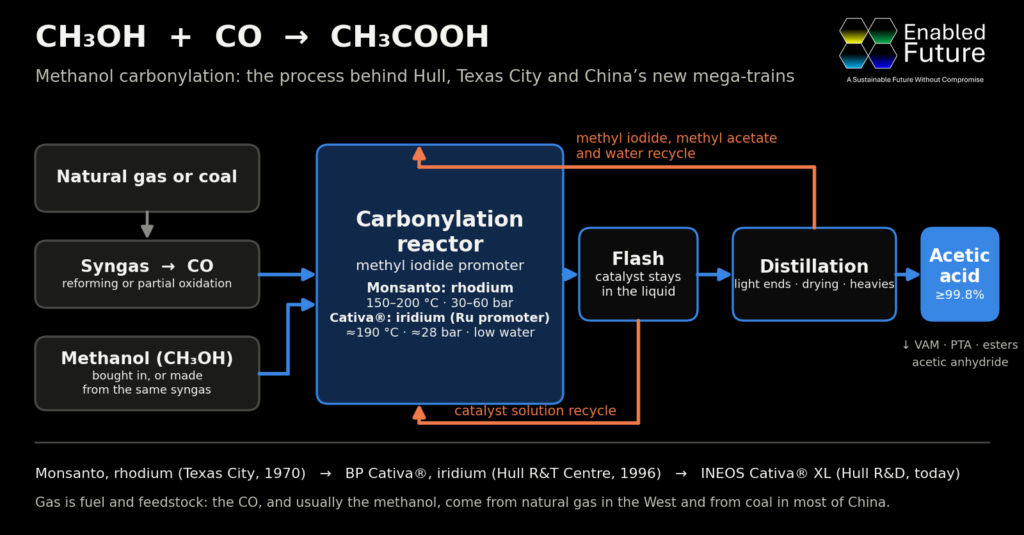
The technology’s intellectual history long predates INEOS. Monsanto commercialised the original methanol carbonylation process in 1970 and BP acquired it in 1986. As Jane Jones documented in Platinum Metals Review in 2000, writing from BP Chemicals’ Hull Research & Technology Centre, BP’s Cativa process replaced Monsanto’s rhodium catalyst with an iridium catalyst promoted by ruthenium, allowing less severe process conditions and commercially viable large single-train units. Cativa went on to underpin BP’s, and now INEOS’s, plants in the US, the UK and Asia, as BP expanded the acetyls business from Hull through joint ventures and licences.
BP’s decision to sell its acetyls and aromatics businesses to INEOS came in 2020. Since then INEOS has continued to operate, optimise and commercialise the technology. Its 2024 annual report states that Cativa “has been continuously optimized and commercially operated in multiple plants since first being deployed over 25 years ago”, and that the latest version, Cativa XL, “offers advantaged capital efficiency through reduced process complexity and variable cost improvements through efficient heat integration leading to reduced steam consumption”.
The register behind this article shows something else about technology, and it sits entirely outside the gas price. China’s new capacity is not being built on Western licences. Jiangsu Sopo and Yankuang run on process technology from the Southwest Research & Design Institute of Chemical Industry. The Huayi group runs its own carbonylation package at Anhui and Guangxi, and when it shut the Wujing plant in September 2025, the first plant BP licensed in China, in 1993, it replaced the tonnes with a new 800,000 t/y unit of its own at Caojing. Juzhengyuan’s 1.5 million t/y train at Jieyang, the largest in the world, runs on what its owner describes as domestically developed rhodium technology. Kingboard’s 800,000 t/y plant at Xingtai goes a step further, using carbon dioxide captured from its own flue gas, with low-energy capture technology developed at Tsinghua University, as part of its feedstock. A BP licence has been retired, and China’s research institutes and universities now supply the process, catalyst and carbon technology for most of the capacity being added anywhere in the world. That is a competitive fact about research capability, not about Westminster, and it puts a premium on INEOS’s ability to keep Cativa ahead. INEOS’s own annual report says that work is done in Hull.
An unwitting casualty of the Hull mothballing: UK catalysis
There is one fact that the entire gas-price and policy squabble misses. Hull was an early UK hero of catalysis. The science behind Cativa originated largely with BP scientists at Saltend and with Johnson Matthey at Royston, Hertfordshire, and it gave a British site the process that the rest of the world’s producers had to match. Hull remains INEOS Acetyls’ global R&D site: the 2024 annual report records 20 full-time R&D staff there, focused on improving operating costs and supporting the joint ventures. The question that should sit alongside the gas price is whether the UK government and UK industry ever did enough to support that capability, and whether they are doing enough now. It should arguably be the basis for a rethink of government support for the Hull sites, which still house world-class scientists and scale-up facilities alongside the production plants.
The UK excels at catalysis and chemical process technology. It ships the hard-earned results around the globe, and catalyst and catalytic-process products and services have contributed billions to the UK trade balance over the last half-century. One might ask whether that initial return on investment is now eating itself. The answer might be: only if we keep placing the emphasis on domestic production, when our real skill and opportunity lie in research and innovation.
If, on the other hand, the emphasis is domestic capacity competitiveness, that ought to have been factored into the engineering, licensing and production contracts and their pricing. Arbitrage was always going to be the enemy. Licensing contracts could have been structured so that low-cost production headed for export markets carried higher royalties, set high enough to stem the ability of any single country or company to dominate.
The problem with that approach is that only one producer or licensor needs to prioritise short-term gains, and most Western chemical producers and licensors have. They built castles in low-cost regions, migrated their customer base along with them, and then completed the transaction by moving their operations out of the UK and Europe altogether. Compared with that full relocation, INEOS has shown considerably more loyalty to the UK than most, and a real commitment to low-carbon feedstocks and energy-efficient projects. But it still played a strong role in globalisation, and not only in acetic acid; olefins are a case in point. EnabledFuture maintains its position: you cannot expect to compete against yourself. One of you is going to lose.
Where criticism of the UK government does stand up to scrutiny is the decision to drop support for one of our most prized technology sectors: catalysis. EnabledFuture would like to hear leading business figures such as Sir Jim Ratcliffe amplifying that point, in their technology-package pricing as well as in their public commentary. He could start with the Acetyls R&D team in Hull, and add the decision by Westminster to make over £160 million of science research budget cuts, including those affecting the Science and Technology Facilities Council’s Oxfordshire facilities at Harwell. The Diamond synchrotron and STFC’s ISIS neutron and muon source there are where UK researchers watch catalysts working under real process conditions, and the UK Catalysis Hub itself is based on the same campus. For catalytic science, that infrastructure is indispensable.
Whose accountability is it anyway?
Accountability is not quite the right question; the better one is what should be accounted for. Answering it well means drawing a wider causal boundary than the one implied by a comparison between the UK gas price and Henry Hub.
The current energy differential is damaging and, at September 2026 prices, Hull faces an exceptionally difficult operating environment. That much is settled. As this article has laid out, INEOS, like many of its peers, has also invested considerably in global activities that do not support the continued operation of its UK and EU assets.
That determines what policymakers should establish before considering support for the site. The supply-chain question is where the tonnes previously made at Saltend will now come from, and how much of the replacement volume will be supplied from INEOS-controlled or INEOS-supported capacity in the United States and Asia. The commercial question is what level of energy-cost relief would change the preferred production location inside INEOS’s own network, and what capital and operating commitments INEOS would make at Hull if that relief were provided. The downstream question concerns the roughly 90 European acetic acid customers identified in INEOS’s reporting, including the two co-located at Saltend, INEOS Europe and Mitsubishi, whose own cost and supply positions change when UK and EU capacity disappears.
The government’s initial response, £350 million of co-investment for strategically important chemicals producers and electricity-cost relief through the Supercharger and British Industrial Competitiveness schemes, addresses electricity, not the gas exposure at the centre of INEOS’s argument.
This is where the attribution of responsibility becomes clearer. The evidence supports Sir Jim Ratcliffe’s warning that the UK and European energy environment can destroy the economics of energy-intensive chemical production. It also establishes that INEOS, along with many other Western chemical supply-chain players, has been an active architect of the global production system against which Hull competes. These causes operate together.
Public policy sets part of the regional cost base; global capacity investment determines supply; technology licensing spreads production capability; corporate capital allocation strengthens selected assets; procurement and feedstock choices determine variable cost; and portfolio optimisation decides which tonnes reach customers. For Hull, all of those decisions have now converged.
A complete account of the mothballing therefore has to include the price of British energy and carbon alongside the capital INEOS has put into the USA, China and India, and the licensees, new and inherited, that it continues to support. Leaving those factors outside the causal boundary would transfer accountability away from decisions that materially changed the competitive landscape. It would also risk ignoring the real skills and opportunities that sit inside the Saltend site.
For governments and downstream supply chains, the issue is therefore larger than whether one company should receive lower energy costs, or whether business customers should be supported more than households, or whether the real matter is not price at all but security of supply. In which case INEOS is the most heard case study, but not the most vital. Those are matters for energy producers and policymakers to deliberate. What EnabledFuture would like to see is recognition that without the catalyst science, the whole topic would be moot, because the UK would not be participating in the front-end development of new, more efficient chemical processes as it was three decades ago, when Cativa emerged as the most prestigious acetic acid technology on the planet.
Unless we shore up our commitment to nurturing the UK’s world-class contribution to industrial catalysis, we risk seeing that disappear to foreign shores too, to places where governments are prepared to give it the attention and capital it deserves. That would be a national disgrace, with a future price tag none of us is prepared for.
EnabledFuture Global Technology Competitiveness Dashboards
The content in this article was generated from the EnabledFuture Global Technology Competitiveness Dashboard for acetyls. Offered as a subscription service, it covers plant ownership and equity participation, nameplate capacity, operating status, feedstocks, plant configuration, technology lineage, licensing relationships, catalysts, precious-metal consumption and downstream supply chains. Please enquire for a demonstration.
Research cut-off: 24 September 2026. Monetary conversions are approximate nominal sterling equivalents at contemporaneous exchange rates. Project investment is not attributed to INEOS where its equity contribution has not been publicly disclosed. Plant and technology evidence prioritises company filings, official disclosures and primary sources.
References
1. INEOS. INEOS idles Europe’s last world-scale Acetyls plant as energy prices hit 12 times US level. 22 September 2026. https://www.ineos.com/news/shared-news/ineos-idles-europes-last-world-scale-acetyls-plant-as-energy-prices-hit-12-times-us-level/
2. The Guardian. Jim Ratcliffe halts production at Hull chemical plants as gas prices soar. 22 September 2026. https://www.theguardian.com/business/2026/sep/22/jim-ratcliffe-halts-production-hull-chemical-plants-gas-prices-ineos-uk
3. The Chemical Engineer. Humberside engineers “distressed” as INEOS suspends UK acetyl production over high gas prices. September 2026. https://www.thechemicalengineer.com/news/humberside-engineers-distressed-as-ineos-suspends-uk-acetyl-production-over-high-gas-prices/
4. Reuters. INEOS to mothball three chemical plants as high energy costs hit production. 22 September 2026. https://www.reuters.com/world/uk/ineos-mothball-three-chemical-plants-high-energy-costs-hit-production-2026-09-22/
5. Office for National Statistics. The impact of higher energy costs on UK businesses: 2021 to 2024. https://www.ons.gov.uk/economy/economicoutputandproductivity/output/articles/theimpactofhigherenergycostsonukbusinesses/2021to2024
6. Department for Energy Security and Net Zero. Quarterly Energy Prices, Table 3.4.1: Prices of fuels purchased by non-domestic consumers in the UK. Published 30 June 2026 (2026 Q1 provisional). https://www.gov.uk/government/statistical-data-sets/gas-and-electricity-prices-in-the-non-domestic-sector
7. INEOS. INEOS completes the acquisition of BP’s global Aromatics & Acetyls business. 1 January 2021. https://www.ineos.com/news/shared-news/ineos-completes-the-acquisition-of-bps-global-aromatics–acetyls-business/
8. BP. bp agrees to sell its petrochemicals business to INEOS. 29 June 2020. https://www.bp.com/press-and-publications/press-releases/bp-agrees-to-sell-its-petrochemicals-business-to-ineos
9. INEOS Quattro Holdings Limited. Annual Report 2024, The Acetyls Business, pp. 91–98. https://www.ineos.com/globalassets/investor-quattro-ir/public/annual-reports/ineos-quattro-holdings-limited—annual-report-2024.pdf
10. INEOS. INEOS invests £30 million to slash emissions at Hull site by 75%. 17 July 2025. https://www.ineos.com/news/shared-news/ineos-invests-30-million-to-slash-emissions-at-hull-site-by-752/
11. INEOS. INEOS completes the acquisition of the Eastman Texas City site. December 2023. https://www.ineos.com/news/ineos-group/ineos-completes-the-acquisition-of-the-eastman-texas-city-site/
12. INEOS. INEOS to build world scale acetic acid plant and associated derivatives on US Gulf Coast. 16 June 2022. https://www.ineos.com/news/shared-news/ineos-to-build-world-scale-acetic-acid-plant-and-associated-derivatives-on-us-gulf-coast/
13. INEOS. INEOS in Review 2024, pp. 7–8 (INEOS Acetyls). https://www.ineos.com/contentassets/f05d7065b5b84a9ba261effcab530850/ineos_in_review_2024.pdf
14. INEOS. INEOS and GNFC sign a Memorandum of Understanding to build a new world scale acetic acid unit in India. 20 November 2024. https://www.ineos.com/news/shared-news/ineos-and-gnfc-sign-a-memorandum-of-understanding-to-build-a-new-world-scale-acetic-acid-unit-in-india/
15. Gas World. INEOS and Sandpiper to develop $1.7bn blue methanol plant in Texas City. April 2026. https://www.gasworld.com/story/ineos-and-sandpiper-to-develop-1-7bn-blue-methanol-plant-in-texas-city/2248649.article/
16. Yoneda, N., Kusano, S., Yasui, M., Pujado, P. and Wilcher, S. Recent advances in processes and catalysts for the production of acetic acid. Applied Catalysis A: General, 221 (2001), 253–265. https://www.sciencedirect.com/science/article/abs/pii/S0920586100002637
17. Jones, J. H. The Cativa™ Process for the Manufacture of Acetic Acid. Platinum Metals Review, 44(3) (2000), 94–105. https://technology.matthey.com/article/44/3/94-105/
18. United States Court of Appeals for the Eighth Circuit. BP Chemicals Ltd v. Jiangsu SOPO Corporation, opinion of August 2005 (records BP’s 1993 licence to Shanghai-Wujing). https://ecf.ca8.uscourts.gov/opndir/05/08/041814P.pdf
19. Shanghai Huayi Energy Chemical Co. Ltd. Announcement on the permanent shutdown of the Wujing methanol and acetic acid units. Shanghai Securities News, 13 September 2025. https://paper.cnstock.com/html/2025-09/13/content_2120784.htm
20. China Chemical Industry News. Acetic acid production technology in China (Southwest Research & Design Institute of Chemical Industry technology at Jiangsu Sopo and Yankuang). 15 November 2005. https://www.chemnews.com.cn/c/2005-11-15/541364.shtml
21. PROCESS China. Juzhengyuan Jieyang 1.5 million t/y acetic acid unit enters trial production. January 2026. https://chem.jgvogel.cn/c1575033.shtml
22. Kingboard Holdings Limited. Announcement: acetic acid project in Xingtai, Hebei (800,000 t/y; Tsinghua University low-energy carbon capture technology). HKEX, 16 March 2026. https://www.hkexnews.hk/listedco/listconews/sehk/2026/0316/2026031600343.pdf
23. BBC News. Report on UK science research budget cuts affecting STFC facilities. 2026. https://www.bbc.co.uk/news/articles/cr4v0n3z16ko
24. UK Research and Innovation / Science and Technology Facilities Council. Rutherford Appleton Laboratory. https://www.ukri.org/who-we-are/stfc/facilities/rutherford-appleton-laboratory/
25. Malveda, M. P. and Funada, C. Acetic Acid. Chemical Economics Handbook, SRI Consulting, 2003 (2003–05 production estimates used as a cross-check for the 2000 regional figures).
26. EnabledFuture. Global Technology Competitiveness Dashboard for acetyls: acetic acid plant register. Research cut-off 24 September 2026 (source of Table 1 and Figure 2).